
When a critically ill child arrives at a community hospital, every second matters. Yet for many health care teams, these moments are rare - high pressure situations that require immediate action, precision, and confidence.
Children’s Health Foundation is helping address this gap by supporting the expansion of the Paediatric Regional Outreach Program (PROP), delivered through Children’s Hospital, London Health Sciences Centre (LHSC). Thanks to generous donors, PROP equips community hospital teams across Ontario with the tools needed to prepare for the moments they hope never come – but must always be ready for.
High Stakes, Rare Moments
In communities like Woodstock, paediatric emergencies don’t happen every day. Woodstock Hospital does not have an inpatient paediatric program. For teams there, paediatric emergencies can be intense, high-stakes situations that do not occur often enough to build confidence through repetition alone.
“We don’t see these cases often – but when we do, the first few minutes matter most."
Dr. Erica Cleto, Emergency Department physician at Woodstock Hospital
Without regular exposure, even experienced health care professionals can find these situations stressful and unpredictable.
In one simulation scenario on an infant, teams responded to a case of status epilepticus – a life-threatening condition where a seizure lasts longer than five minutes or occurs repeatedly without recovery in between. Rapid recognition and treatment are critical to prevent serious complications, including brain injury or death.
This is what makes preparation so crucial.
Taking Training Where It’s Needed Most
At Children’s Hospital, PROP brings hands-on simulation training directly to community hospitals across Ontario – eliminating barriers like travel, cost, and time.
Led by Dr. Gurinder Sangha, Paediatric Emergency Physician and Medical Director of the simulation program, Children’s Hospital, LHSC, the PROP team travels with everything needed to recreate real emergencies.
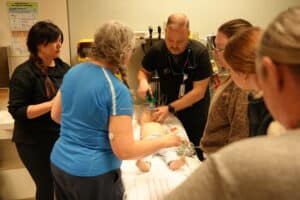
“We bring mannequins, monitors, medications – everything,” says Dr. Sangha. “And whenever possible, we train in their actual clinical spaces using their own equipment.”
That approach allows teams to practice in the exact environment where real patients will arrive – making the learning more realistic, and more effective.
From Knowledge to Action
In emergency medicine, knowing what to do isn’t always enough.
“When you’re stressed, your brain works differently,” says Dr. Sangha. “Even if you know the steps, applying them in real time can be a challenge.”
Simulation helps bridge that gap – turning knowledge into action through repetition, teamwork, and guided debriefing.
“It takes something that feels chaotic and makes it organized,” says Dr. Cleto. “You build that muscle memory so when it happens in real life, you can act.”
Stronger Teams, Better Outcomes
Each PROP session brings together physicians, nurses, and other specialist to practice as a team – just as they would in a real emergency.
Through realistic scenarios and structured debriefs, teams strengthen communication, identify system gaps, and refine how they respond under pressure.
The impact goes beyond clinical skills.
“These are incredibly difficult moments for families,” says Dr. Cleto. “Simulation helps us prepare not just medically, but emotionally – how we communicate, and how we support parents.”
Meeting a Growing Need
Across the region, hospitals are facing increasing demand, workforce changes, and growing patient populations.
Many smaller hospitals don’t have dedicated paediatric teams – but they are often the first point of care for critically ill children.
“These clinicians are managing everything. From seniors to mental health crises to newborns. It’s a lot – and we want to make sure they feel prepared when a child comes through the door.”
Dr. Sangha
PROP aims to reach 33 hospitals across Ontario spanning as far as Thunder Bay, ensuring more than 1,100 health care professionals have access to this specialized paediatric training at no cost to participating hospitals.

Powered by Donor Support
The expansion of this program is made possible through a donation from RBC Foundation to support upskilling healthcare professionals in London and across Ontario.
This investment is part of a broader effort to strengthen frontline health care education during a time of increasing pressure on providers.
“There’s zero risk for hospitals to participate,” says Dr. Sangha. “And once they experience it, they see how valuable it is.”
Your Impact
For teams on the front lines, the difference is immediate.
Because of donor generosity, health care providers across the region are more confident, more prepared, and better equipped to respond when a child’s life is on the line. When those critical moments come, Dr. Cleto knows they’re ready.
“I genuinely feel like this program saves lives and improves outcomes.”
Ainsley Krienselokker
akrienselokker@childhealth.ca


