
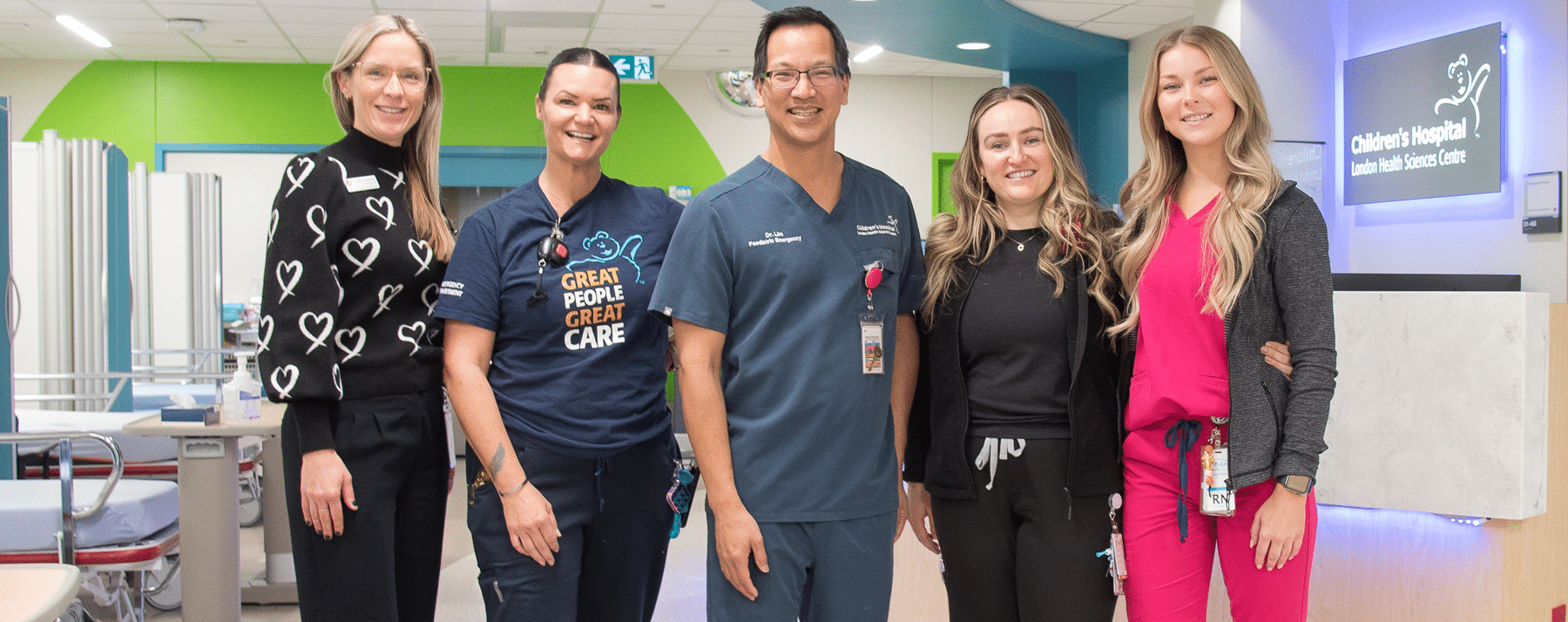
 Most shifts move between the ordinary and the urgent without warning. One room may hold a child who will be discharged within the hour. Another may hold a life-or-limb emergency requiring multiple teams and immediate action.
That pace, and that unpredictability, is part of what defines the job.
But so does what happens outside the hospital.
Dr. Levin is also a parent, raising two young daughters with her husband who also is in the medical field — a surgeon — both working in some of the most demanding areas of medicine. That dual perspective of parent and ED doctor shapes how she sees and listens to families in the ED. She understands the fear that comes when your child looks suddenly, frighteningly unwell.
She also knows what it takes for health care providers to meet that fear with steadiness, compassion, and clear judgment.
It is a balance that requires more than medical expertise. It requires emotional discipline. The ability to move from one family’s worry to another child’s crisis. To absorb pressure without passing it on. To stay calm when a room is anything but calm.
 Also in today’s world — there is a new battleline — and it’s on our phones, tablets and laptops it’s available to everyone — the internet diagnosis and competing with those outcomes that some parents come armed with and working with them to see their child’s case as it is not what the computer may say.
This is a whole new challenge physicians face that no previous generation has. It adds a whole new level of complexity and demands much more dexterity in the listening by Dr. Levin and her team.
That may be the most striking truth about a day in paediatric emergency. Over eight hours, Dr. Levin and her colleagues move through flu, fractures, fear, uncertainty, trauma, relief, and sometimes heartbreak. They make dozens of decisions, have countless conversations, and carry the weight of knowing that every family in front of them is living a day they will remember for a long time.
For the team, it is a shift.
For a parent, it may be the longest eight hours of their life.
And that is why the work matters so much.
Alongside this story, Dr. Helen Levin shares a snapshot of a typical shift — a reminder that in paediatric emergency, no two hours are ever the same.
8:00 PM
The shift begins with a handover from a colleague. Sometimes that means bedside handover for patients who are especially sick or complex, along with meeting families and getting quickly up to speed. There are learners to orient too (often a medical student, resident or fellow) before the night really begins.
8:45 PM One of the first more involved cases is a five-week-old baby with a fever and difficulty breathing. Babies this young can be especially hard to assess because they do not always give many clues before becoming very sick. After a full history and exam, bronchiolitis seems most likely. Even after suctioning and feeding support, the baby is still having trouble breathing and needs to be admitted for observation. The parents are frightened and full of questions. Dr. Levin cannot promise the baby will not get worse, but she can reassure them that their child is in the right place and will be monitored closely.
10:15 PM
Between the most urgent moments are all the other patients who make up a paediatric emergency shift – gastroenteritis, viral illnesses, injuries, fevers and frightened families looking for answers. In a typical eight hours, Dr. Levin may see about 20 patients, each arriving with a different story and a different kind of need.
10:50 PM
A patch phone call comes in from EMS: a seven-year-old boy is on the way after falling from a hay loft more than two storeys high in the early evening. Before he arrives, the team is already assembling – nurses, respiratory therapy, registration and child life – with medications prepared, equipment ready and roles assigned. In paediatric emergency, a shift can change in an instant.
11:15 PM
The child arrives awake and crying – a reassuring sign – but clearly badly hurt. He needs bloodwork, bedside ultrasound, X-rays and CT imaging. The results show a small subdural hemorrhage and a displaced fracture of his femur. Neurosurgery and orthopedic surgery are called. He will need sedation, traction and admission for surgery. One of the hardest parts is that his parents are not with him at first. They are travelling from 45 minutes away and arrive after he does. Until then, child life plays a major role in helping support him through assessments and investigations.
1:30 AM Later in the shift comes a four-year-old with acute lymphocytic leukemia who has developed a fever. For children undergoing chemotherapy, fever always means urgent assessment because the risk of infection is so high. This is a family Dr. Levin knows well. The little boy, despite being only four, already knows almost every step of the process – where his port is, when the numbing cream goes on, when the nurses will come, when the doctor will examine him. It is heartbreaking to see how medicalized a child’s life becomes when serious illness enters the picture.
2:30 AM
This time, there is good news. The child looks well, his bloodwork is reassuring, and after speaking with the oncologist on call, Dr. Levin can tell the family he can go home, with close follow-up and instructions to return if he seems unwell. In emergency medicine, not every win is dramatic. Sometimes the best outcome is simply being able to sleep in your own bed.
4:00 AM
By the end of eight hours, Dr. Levin and her colleagues have moved through fear, uncertainty, trauma, explanation, teamwork and relief. They have listened closely, made rapid decisions and helped families through moments they may never forget. For the team, it is one shift. For a parent, it may be the longest night of their life.
The examples are not specific patients — but an example of typical scenarios and happenings over an 8-hour shift in the Emergency Department at Children’s Hospital.
