
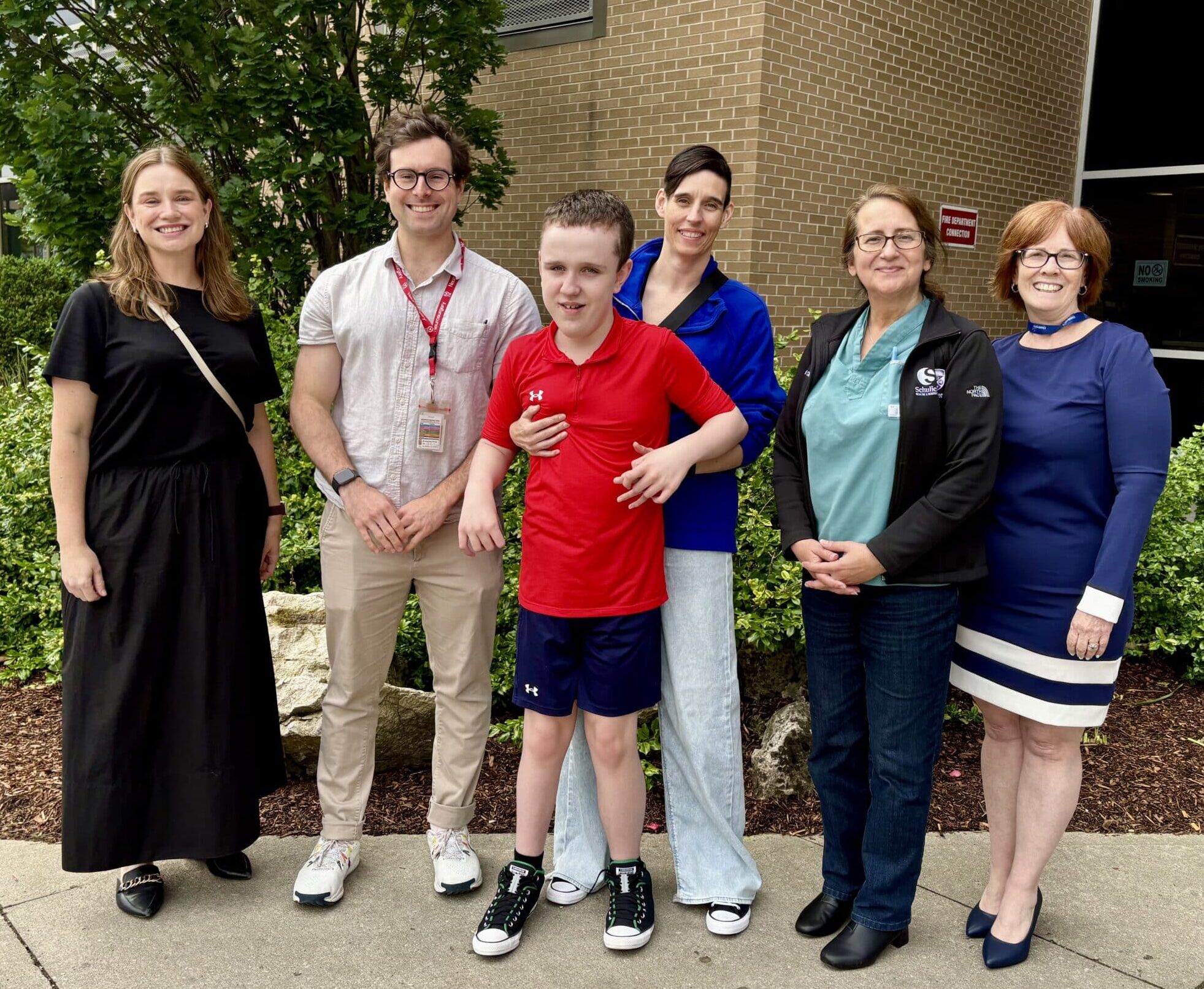
When Stefanie Biggar talks about Children's Hospital at London Health Sciences Centre (LHSC), she doesn't describe it as a place her family just visits.
“It’s kind of like our second home.”
Her son, Dyson, has spent much of his young life in and out of the hospital. Born at just 25 weeks gestation, Dyson experienced a brain bleed when he was only three days old. The complication led to hydrocephalus, a condition caused by a buildup of fluid in the brain. Today, Dyson also lives with cerebral palsy affecting the right side of his body, autism, cognitive delay and epilepsy, and he is non-verbal. Despite these health challenges, Dyson is a super happy and active child.
“We spent the first 115 days of his life here in the NICU,” Stefanie recalls. “We’ve been here on and off ever since.”
Throughout Dyson’s journey, the care he received from Children’s Hospital’s neurosurgery team has played a critical role in his life. When he was two years old, he underwent surgery to have a shunt placed in his brain to help manage his hydrocephalus.
His story is one of inspiration, so much so that it has inspired Stefanies employer, Maglin Site Furniture, to give back in a meaningful way in honour of Dyson.
“When my company said they wanted to make a donation on behalf of Dyson, we immediately thought of neurosurgery because it has been such an important part of his journey,” says Stefanie.
"We wanted to do something that would give back and support research that could improve patient care for future generations."
Stephanie
That vision led to the creation of the Fichter Maglin Award, a new residency award funded through Children’s Health Foundation and administered through the Schulich School of Medicine and Dentistry at Western University. The award will support neurosurgery residents at Schulich Medicine that practice at Children’s Hospital and Children’s Health Research Institute over the coming years, helping advance discoveries that improve care for children and families across the region.
Having cared for Dyson throughout his life, Dr. Adrianna Ranger says the award represents far more than a donation – it is an investment in research that will benefit future patients.
“It has been an overwhelming expression of gratitude and support,” says Dr. Ranger. “I’ve had the privilege of caring for Dyson throughout his journey, and this gift is especially meaningful because it invests in people and research that will improve care for future patients.
"Supporting resident-led research has the potential to make a lasting difference for children living with conditions like hydrocephalus and epilepsy."
Dr. Ranger
The first award recipient is Dr. Alexander Mastrolonardo, a PGY-3 Neurosurgery Resident whose research focuses on improving the accuracy of emergency neurosurgical procedures used to treat patients with acute hydrocephalus and elevated intracranial pressure.
“I think it is a huge honour to receive something like this,” says Dr. Mastrolonardo.
“These awards are a great reminder of why we’re able to do this work. The parents of these children know there is more work to be done, and they’re providing us with the funds to do it.”
His study examines the accuracy of external ventricular drain (EVD) placements, a lifesaving procedure used in emergency neurosurgical situations. The research aims to better understand how patient anatomy can affect placement accuracy and help determine which patients are best suited for bedside procedures.
“This award is directly funding projects and helping us disseminate our research findings,” says Dr. Mastrolonardo. “As the first recipient, I hope to set the stage by showing that this funding is supporting meaningful research.”
For Dr. Mastrolonardo, meeting Dyson and his family brought an even deeper significance to the award.
“It was important to meet and thank the family and Maglin for bringing this award forward,” he says.
"This award itself is coming from a patient who has hydrocephalus. It was heartwarming to know the award is supporting research that is ultimately working toward improving procedures for patients such as Dyson himself."
Dr. Mastrolonardo
The connection between Dyson’s lived experience and the research being supported was equally meaningful for Stefanie.
“It was nice to put a face to the doctor who received the residency award,” she says. “It was lovely to see that the money we donated stays close to home. It was also nice to learn about his research and understand what he plans to do.”
For Maglin, the gift reflects a commitment to supporting the communities and families that rely on Children’s Hospital.
“Children’s Hospital serves the children of Woodstock, where our company is located, and serves the child of one of our employees through Dyson,” says Maggie McAskile, Communications Coordinator at Maglin. “It was really important for Maglin to donate in a way where we could see the impact of our funds. It was so cool to meet Alex and learn about his research and what he hopes to accomplish.”
As the Fichter Maglin Award begins its journey, its impact extends far beyond a single research project. It represents a family’s gratitude, a company’s commitment to community, and an investment in the future of paediatric health care.
Because of partnerships like these, Hope Lives at Children’s.
Celine Zadorsky
czadorsky@childhealth.ca
